less battling in the twitter trenches
Shit Punk Says
Oceans of Wisdom
19,158
matching drops
#1459158
2026-09-22 15:17
need to work on protocol today
gmeme
omg
omg amazing
there is no other way
could seed it
we can do it here somehow
there is nothing out there
it is on my to do list
As tradition requires, the New Year's Day Thread.
And yes, I am remain the most bullish person in the world re NFTs.
https://x.com/punk6529/status/1874496206300156143
here we go, finally did it right
https://x.com/punk6529/status/1874247632903958543
Happy New Year!
i am very happy about that
TDH rate and price are only very loosely correlated
i think people should want a naka for desire and I think they do already
i think it is important that does not change
not of utility
they are objects of desire
BTC has one of the two sides
https://x.com/punk6529/status/1873402695224348804
@[6529Guardian] @[itsjpower] @[BatSoupYum] @[krybharat] @[ACtheCollector] @[Noone0x]
enjoy
**Disclaimer:** The following discussion is for general informational purposes only and does **not** constitute legal or tax advice. It is intended as a deep-dive analysis from the perspective of a practitioner who is highly experienced in cryptocurrency regulation and tax law. You should consult with a qualified attorney or tax professional for advice tailored to your specific circumstances.
## I. Introduction
On [DATE], the Internal Revenue Service (IRS) released Notice 2024-57, providing interim guidance (and penalty relief) on certain transactions involving digital assets. Broadly, the Notice establishes that brokers will **not** be required to report gross proceeds or furnish payee statements for a select group of identified digital asset transactions. Until further determination is made, the IRS will not impose penalties under sections 6721 and 6722 of the Internal Revenue Code (IRC) for failure to file or furnish information returns relating to these transactions.
This Notice is significant because it explicitly acknowledges the complexity of many DeFi (decentralized finance) and other crypto-centric arrangements. The IRS effectively carves out (at least for the time being) some of the more complicated or arguably “non-sale” transactions—such as wrapping, unwrapping, liquidity provision, staking, certain “lending” and “short sale” arrangements, and notional principal contracts (NPCs) involving digital assets—from **mandatory** broker reporting under section 6045.
The following sections provide a hyper-detailed, hyper-long analysis of Notice 2024-57, addressing its context, background, the specific transactions covered, and the broader regulatory and tax implications.
## II. Background on Section 6045 and Digital Asset Reporting
### A. Statutory Background
1. **Section 6045(a)**
- Imposes a requirement on every “broker” (broadly defined) to make a return (information return) to the IRS for each customer, showing names, addresses, gross proceeds, and any other information required by the Secretary of the Treasury or delegate.
- Historically, brokers have filed Form 1099-B for securities transactions, but since the Infrastructure Investment and Jobs Act (“Infrastructure Act”) and the IRS’s subsequent guidance, digital assets have become subject to these broker reporting rules.
2. **Infrastructure Act Changes**
- Enacted in November 2021, Section 80603 of the Infrastructure Investment and Jobs Act expanded the definition of “broker” to clarify that digital asset trading platforms, certain hosted wallet providers, payment processors, and kiosks that facilitate digital asset transactions could be required to file information returns.
- It similarly expanded reporting for basis information to include digital assets, making the taxation (at least in theory) closer to that for stocks, bonds, and other securities.
3. **Regulatory Developments (TD 10000)**
- On June 28, 2024, the IRS and Treasury Department issued final regulations (TD 10000) to implement the expanded broker reporting rules for digital assets. These rules require brokers to file new Form 1099-DA, reflecting proceeds from digital asset transactions.
4. **Scope of “Digital Asset”**
- Under Section 6045(g)(3)(D) and Treas. Reg. § 1.6045-1(a)(19), a “digital asset” is any digital representation of value recorded on a cryptographically secured distributed ledger (or similar technology), not including cash. The breadth of this definition spans typical cryptocurrencies (like BTC, ETH), stablecoins, and potentially tokens that have other utilities.
5. **Penalties for Non-Compliance: Sections 6721 and 6722**
- Section 6721 imposes penalties for failing to file an information return or for filing an incomplete or incorrect return with the IRS.
- Section 6722 imposes penalties for failing to furnish or providing incorrect payee statements to the recipient (customer).
- Section 6724(d)(1)(B)(iii) designates a return required under Section 6045(a) or (d) as an “information return.” Similarly, Section 6724(d)(2)(H) designates a statement required under 6045(b) or (d) as a “payee statement.”
### B. Rationale for Relief
In Notice 2024-57, the Treasury Department and the IRS acknowledge that many crypto transactions defy easy categorization. Transactions like “wrapping,” “unwrapping,” providing liquidity in automated market maker (AMM) pools, certain staking, and certain lending or short-sale-like transactions may (1) not clearly be “sales” for tax purposes, or (2) be sufficiently complicated that it is not yet feasible to require immediate broker reporting. As a result, the IRS is providing interim relief: these transactions (termed “identified transactions”) will not be subject to 6045 reporting or the associated penalties during this transitional phase.
## III. Overview of Notice 2024-57
### A. Identified Transactions (Section 3)
Notice 2024-57 focuses on six categories of “identified transactions”:
1. **Wrapping and Unwrapping Transactions** (Section 3.02)
2. **Liquidity Provider Transactions** (Section 3.03)
3. **Staking Transactions** (Section 3.04)
4. **Transactions Described by Market Participants as Lending of Digital Assets (Type 1)** (Section 3.05)
5. **Transactions Described by Market Participants as Short Sales of Digital Assets (Type 2)** (Section 3.06)
6. **Notional Principal Contract (NPC) Transactions** (Section 3.07)
The Notice explains that these types of transactions require additional study to determine how best to facilitate appropriate reporting. Therefore, **until the IRS issues further guidance**, brokers are not required to file Form 1099-DA for these transactions, nor furnish payee statements, and no penalties will be imposed under sections 6721 or 6722 for non-reporting (or inaccurate reporting) of these transactions.
### B. Limited Purpose; No Substantive Determination
Crucially, the Notice states that its descriptions of these transactions:
- **Do not** represent a substantive determination of whether each transaction is, in fact, a sale or exchange of a digital asset for tax purposes.
- **Do not** determine whether these transactions *would* be reportable under Section 6045 if not for the penalty relief.
- **Do not** limit the possibility that certain aspects of these transactions *could* trigger other Code-based reporting obligations (for example, reporting ordinary income under different informational reporting regimes).
### C. Effective Date
The relief is effective for identified transactions occurring on or after January 1, 2025. This lines up with the broader timeline for newly enacted digital asset broker reporting requirements, giving the IRS additional time to study these issues.
## IV. Transaction-by-Transaction Analysis
Below is a detailed breakdown of each category of transaction covered by Notice 2024-57, accompanied by an in-depth legal and tax analysis.
### 1. Wrapping and Unwrapping Transactions (Section 3.02)
**Description:**
“Wrapping” in the cryptocurrency space typically means taking a digital asset native to one blockchain (for example, Ether on the Ethereum mainnet) and locking it in a smart contract so that a “wrapped” version of it can circulate on another blockchain or have a different set of functionalities (e.g., using wrapped BTC (WBTC) on Ethereum DeFi protocols). “Unwrapping” reverses that process.
- **Section 3.02(1)(a)** describes transferring a single type of digital asset (digital asset A) in return for another digital asset (digital asset B) that is (i) redeemable solely for A, except possibly some extra functionalities or at times limitations, and (ii) “identical” to A except for the fact that it is “wrapped.”
- **Section 3.02(1)(b)** covers the redemption of digital asset B back into A (the “unwrapping”), even if you also get certain airdrops or other property credited during the time that the asset was wrapped.
**Observations & Key Considerations:**
1. **Is Wrapping a Taxable Exchange?**
- Historically, many practitioners have argued that wrapping (e.g., wrapping ETH into WETH) is a non-taxable “like-kind” transaction or, more specifically, an event that does *not* constitute a sale or exchange under Section 1001. The IRS has never issued direct authoritative guidance, so uncertainty abounds.
- Notice 2024-57 suggests the IRS also acknowledges this uncertainty but effectively postpones the question.
2. **Broker Reporting Complexity:**
- If you are a trading platform or a DeFi protocol enabling wrap/unwrap operations, do you track cost basis or “gross proceeds” for a wrap? Under typical reporting rules, you might question whether a “wrap” is a disposal. The Notice says, for now, no reporting is required.
3. **Airdrops Accrued During Wrapping Period:**
- The Notice clarifies that it is not addressing whether airdrops or other rewards credited to the wrapped asset holder might be taxable and, if so, subject to *other* forms of reporting.
4. **Implications for Stakeholders and Platforms:**
- Centralized exchanges offering “wrapped” versions of tokens might not have to generate 1099-DAs for these transactions during this relief period.
- Future guidance could require robust record-keeping by platforms to differentiate pure “wrap/unwrap” transactions from actual “exchanges” of different digital assets that might be taxable dispositions.
### 2. Liquidity Provider Transactions (Section 3.03)
**Description:**
This deals with “automated market maker” (AMM) or “liquidity pool” transactions commonly found on DeFi platforms like Uniswap, SushiSwap, Curve, etc.
- **Section 3.03(1)(a)** describes depositing one or more digital assets (e.g., assets C and D) into a smart contract, receiving in return a “liquidity token” or “LP token” (digital asset L) that represents a proportional interest in the pool.
- **Section 3.03(1)(b)** describes the “redemption” of L for a proportional share of the underlying digital assets in the pool, which may or may not be the identical composition of tokens that were originally deposited.
**Observations & Key Considerations:**
1. **Traditional Tax Uncertainty:**
- The big question for liquidity provision has long been whether depositing digital assets into a liquidity pool triggers a taxable event. Some practitioners analogize depositing tokens into a pool to forming a partnership or a new intangible arrangement, potentially a non-taxable contribution under certain partnership rules. Others see it as exchanging assets for a distinct “LP token,” which could be a taxable event if the assets are not considered “like kind.”
- The Notice acknowledges the difficulty of applying 6045 reporting to these transactions, especially if the “pool tokens” are themselves extremely dynamic in value and composition.
2. **Reporting Mechanics:**
- Platforms would need to keep track of an investor’s cost basis in each digital asset contributed, the fair market value at the time of deposit, and the fair market value of tokens withdrawn at redemption—an administrative and technological challenge.
- Because many AMMs feature thousands of liquidity pools with dynamic reward mechanisms, the data requirements for broker reporting become non-trivial.
3. **Reward/Interest-Like Income:**
- If the liquidity pool pays out periodic “fees” or “rewards” in digital assets, those might be subject to separate reporting under forms like 1099-MISC or 1099-INT if the platform is a broker or subject to other reporting regimes. The Notice specifically states that penalty relief under Section 6045 does not preclude the possibility that these “rewards” are otherwise reportable as ordinary income under some other code provision.
4. **Future Outlook:**
- Over the long term, the IRS will likely issue more definitive rules on whether these deposits and redemptions are “exchanges,” “contributions to partnership,” or something else entirely. A key question is whether the digital asset L is “substantially identical” to the underlying pool assets or if it is considered a separate intangible with distinct tax treatment.
### 3. Staking Transactions (Section 3.04)
**Description:**
Staking occurs when users “lock up” their tokens in a proof-of-stake (PoS) network (either directly or through pooled staking services) to help validate transactions and secure the network, typically earning “validation rewards.” The Notice splits staking into two broad patterns:
- **Direct Staking (Section 3.04(1)(a))**: A user deposits digital asset E into a contract for PoS validation. In return, the user might get the same digital asset E back eventually, plus any additional tokens generated as staking rewards.
- **Pooled Staking (Section 3.04(1)(b))**: A user deposits E into a contract, receiving a different digital asset (S) that represents the user’s interest in the staked E. Redeeming S returns a share of E plus any staking rewards.
**Observations & Key Considerations:**
1. **Is Staking a Sale?**
- Many in the crypto community have argued that staking is not a “sale” but rather akin to depositing money in a savings account. However, the question remains unsettled.
- The Notice puts a pin in the question for 6045 purposes, indicating no reporting is required in these scenarios for now.
2. **Taxation of Rewards**
- The Notice explicitly does *not* decide whether newly minted tokens are immediately taxable income, or how they should be characterized (interest, ordinary income, or something else).
- Proposed or ongoing litigation and commentary (such as the Jarrett case) highlight that the broader tax community is awaiting official IRS guidance on whether reward tokens are taxed upon creation or upon disposal.
3. **Broker Reporting Challenges**
- If a platform were treated as a broker for staking, it would have to track (a) the user’s deposit, (b) any interim disposal or transformation, (c) the redemption, and (d) any newly minted tokens credited to the user. Technically complicated.
- Many staking protocols are decentralized or permissionless, making it unclear who the “broker” even is.
4. **Implications for Taxpayers**
- Taxpayers should still keep careful records of all staking activities and token receipts, because while no 1099-DA is required for the staking deposit/redemption, they may eventually owe tax on the rewards.
- The Notice’s relief does *not* mean these transactions are non-taxable; it only affects the broker reporting obligations.
### 4. Digital Asset “Lending” Transactions (Type 1) (Section 3.05)
**Description:**
A “type 1” lending transaction is described as one where a taxpayer (original digital asset owner) transfers a digital asset to another party (the transferee), subject to an obligation for that party to return *the same type* of digital asset at a future date. The transferee may also pay or credit additional digital assets as a form of compensation (akin to “interest”) or to reimburse the original owner for any airdrops or forks that occur.
**Observations & Key Considerations:**
1. **Comparison to Securities Lending**
- In traditional finance, securities lending (e.g., lending shares of stock) often triggers special tax considerations (e.g., Section 1058). If certain conditions are met, a securities loan might not be treated as a disposition by the lender, but the lender is still taxed on certain forms of compensation (e.g., “substitute payments”).
- For crypto, there is no direct statutory analog to Section 1058 (which is specific to “securities,” not digital assets). The Notice suggests the IRS is still studying whether or how to apply that logic in the digital asset context.
2. **Is This a “Sale” or Exchange?**
- If the original digital asset owner relinquishes control and no longer holds the asset, some might argue that is a “disposition.” Others say the forced return of an “identical” token means the beneficial ownership never changed.
- The Notice effectively says: *We’re not sure yet; no 6045 reporting for now.*
3. **Practical Compliance Issues**
- If a centralized exchange or a DeFi lending protocol is considered a “broker,” would it have to issue a 1099 showing a “sale” for the initial deposit, and then another 1099 for the “buy” on redelivery? Right now, the IRS is disclaiming that requirement for these “lending” transactions.
4. **Income Reporting**
- “Interest” or reward tokens received by the original owner might be “ordinary income.” However, the Notice does *not* address whether some other informational reporting (like 1099-INT, 1099-MISC, etc.) might apply.
- It merely states that the receipt of such additional tokens or compensation is not covered by the 6045 relief if it otherwise must be reported under a different Code section.
### 5. Digital Asset “Short Sale” Transactions (Type 2) (Section 3.06)
**Description:**
A “type 2” transaction parallels a short sale in traditional finance:
- The taxpayer obtains digital assets from an original owner under an obligation to return the same type of digital asset in the future.
- The taxpayer sells them immediately to an unrelated party.
- Eventually, the taxpayer must deliver “like” digital assets back to the original owner—perhaps purchasing them on the open market or using ones already held.
**Observations & Key Considerations:**
1. **Traditional Finance vs. Crypto**
- Short sales of stock or securities are typically subject to specialized rules under the Internal Revenue Code (e.g., Section 1233). Gains may not be realized until the short position is closed. Dividend income may result in “in-lieu-of” payments.
- In crypto, the mechanics can be more variable. Some protocols allow shorting without a centralized broker, raising the question: *Who is responsible for broker reporting?*
2. **Possible “Sale” at the Outset**
- In typical short sales, the “short seller” is treated as selling borrowed securities, but the tax realization event often occurs upon closing the short. In the digital asset context, the question is whether the initial arrangement or the final settlement triggers the “sale” for 6045 reporting.
- The Notice again defers, stating that penalty relief is granted, so no 6045-based forms are needed for type 2 transactions for now.
3. **Income to the Lender**
- Similar to securities lending, the original digital asset owner might receive compensation for “loaning out” the token. That compensation could be interest-like income or a “substitute payment.” The Notice clarifies this might be subject to other information reporting (for example, 1099-MISC), but not 1099-DA for now.
### 6. Notional Principal Contract (NPC) Transactions (Section 3.07)
**Description:**
An NPC is defined under Treas. Reg. § 1.446-3 generally as a financial instrument that provides for periodic or one-time payments calculated by reference to a “notional” amount. Common examples in traditional finance are total return swaps, interest rate swaps, etc.
In the crypto context, an NPC might also be tokenized or otherwise structured as a digital asset. Section 3.07 identifies two broad categories:
- **Payments under, or sale/assignment of, an NPC** that uses or references a digital asset.
- **Termination of an NPC** that itself is a digital asset.
**Observations & Key Considerations:**
1. **Treatment under Existing NPC Regulations**
- Existing NPC rules revolve heavily around interest rate swaps, equity swaps, commodity swaps, etc. Whether or not a cryptocurrency-based derivative qualifies as a “notional principal contract” can be complicated, especially if the underlying reference is a digital asset.
- Some crypto arrangements might be forward contracts or options, not NPCs. Others might indeed be structured to fall under NPC definitions, but the lines are blurred.
2. **Broker Reporting Under 6045**
- The final regulations (TD 10000) suggest that certain digital asset derivatives or similar products may be within scope of broker reporting. But the IRS is clearly recognizing that notional principal contract rules become particularly complex when applied to digital assets, especially if the “swap” is performed on a decentralized protocol.
3. **Practical Consequences**
- During this interim period, participants in digital asset NPCs (like total return swaps referencing a basket of cryptocurrencies) need not file 1099-DAs. But they still must keep robust records for potential capital gains or ordinary income reporting.
- Gains or losses recognized on NPCs might still be subject to self-reporting on Form 8949 or other relevant forms, consistent with existing rules for derivatives transactions.
## V. Impact and Future Implications
### A. Relief from Penalties, Not from Taxation
The most important clarifying point in Notice 2024-57 is that the IRS is granting **relief from broker reporting penalties** under Sections 6721 and 6722 for these specific “identified transactions.” This does **not** mean that the IRS deems these transactions to be non-taxable. Taxpayers are still responsible for:
- Determining whether any gain, loss, or income arises from each transaction.
- Self-reporting on their own tax returns, as appropriate.
- Potentially reporting under other provisions if they receive certain forms of income.
### B. Timing of Further Guidance
The Notice implies that the IRS plans to study these transactions and issue further regulations or guidance to clarify when (and how) they should be reported by brokers. This process could take years, considering the complexity and the pace of change in the digital asset industry.
### C. Defining “Broker” in Decentralized Protocols
A persistent uncertainty is how the IRS interprets the concept of “broker” in decentralized contexts:
- If a protocol is purely algorithmic, with no central controlling entity, who (if anyone) is obligated to file 1099-DA?
- The final regulations (TD 10000) suggest that persons receiving transaction fees or providing facilitative services could be considered brokers. But questions remain about fully decentralized, self-executing code that is not controlled by a single legal entity.
### D. Potential for Overlapping Reporting Regimes
Even though the transactions are carved out from 6045(broker) reporting, the IRS has not exempted them from other types of reporting or from the underlying tax consequences. That means:
- Centralized exchanges might still issue other types of forms (e.g., 1099-MISC, or 1099-B for transactions not covered by the Notice).
- Payment for services in crypto might still require a 1099-NEC or W-2 (if wages).
- If a digital asset meets the definition of a “security,” forms 1099-DIV or 1099-INT could be relevant.
## VI. Compliance Considerations for Stakeholders
1. **Brokers and Exchanges**
- **Short Term (2024 – 2025):** Exchanges or brokers can rely on Notice 2024-57’s statement that for these enumerated transactions, no broker reporting is required. However, they must still comply with 6045 and furnish 1099-DA for transactions *not* included in the “identified transactions.”
- **Record Keeping:** Despite the penalty relief, it is prudent to maintain robust user transaction logs and cost-basis tracking, in anticipation of future guidance.
2. **DeFi Protocol Operators**
- Many DeFi protocols operate in a decentralized manner, which complicates the question of whether they are “persons” that can be regulated as brokers. Operators or front-end developers may want to pay close attention to future clarifications, as the final regulations left open the possibility that they could be “digital asset middlemen.”
- On transactions like liquidity pool contributions or token swaps, DeFi protocol operators might eventually face new compliance burdens—once the IRS decides exactly how these “wrap,” “unwrap,” “LP token,” or “staking token” transactions should be reported.
3. **Taxpayers/Investors**
- **Self-Reporting:** Even without a 1099-DA, taxpayers must be careful about calculating and reporting gains, losses, and income from these transactions if they turn out to be taxable.
- **Documentation:** Keeping detailed records of cost basis, fair market value at the time of deposit or redemption, and any extra tokens or rewards received is crucial. The absence of a 1099 form does **not** remove the taxpayer’s duty to accurately self-report.
- **Consultation:** Given the complexity, many taxpayers should consider professional advice to avoid under-reporting or mischaracterizing these transactions.
4. **Institutional Players (Custodians, Funds, etc.)**
- Institutions that engage in digital asset transactions must consider whether their activities fall under these “identified transactions.” They may be subject to different or additional compliance obligations depending on how the IRS eventually finalizes or expands the guidance.
- For instance, a hedge fund employing short-sale strategies (type 2) or “yield farming” strategies (liquidity provider transactions) might rely on the Notice to avoid certain 6045 reporting, but they still must handle standard partnership tax reporting, investor K-1s, or relevant corporate tax forms.
## VII. Conclusion
Notice 2024-57 represents an important interim step in the IRS’s ongoing effort to reconcile crypto/DeFi innovation with the existing tax reporting framework. By carving out these “identified transactions” from mandatory broker reporting—wrapping/unwrapping, liquidity provisioning, staking, certain lending/short-sale arrangements, and notional principal contract transactions—the IRS acknowledges their complexity and the challenges faced by both taxpayers and “broker
Cooking was a success, eating was a success, soon sleeping it off will also be a success!
And happy digestion to all those too!!!
Merry Xmas and Happy Hannukah to all those who celebrate!
and a chain / project needs to go through HARD TIMES. Hard times build culture, not good times
go go go - grocery shopping this morning lol
lol
https://x.com/netcapgirl/status/1870978778026918105
https://x.com/punk6529/status/1870974991463772278
https://x.com/punk6529/status/1870419613097312490
It's over. I updated my priors a year ago. It is AGI YE 2025, ASI 2027-2028, humanoid general purpose robotics 2030
https://x.com/__nmca__/status/1870170098989674833?s=09
AGI 2025 fully on track. Age of man is coming to an end. Brave new horizons ahead
about to have some pizza tonight but unfortunately a restaurant is going to make it and deliver to to me. sorry @[DeyvisMalta] - not yet the time!
I am just talking about branding (not architecture!)
punk6529 just a guy, progressively less important every year if all goes well ;)
@[simo] maybe we drop to LVL5 the gate
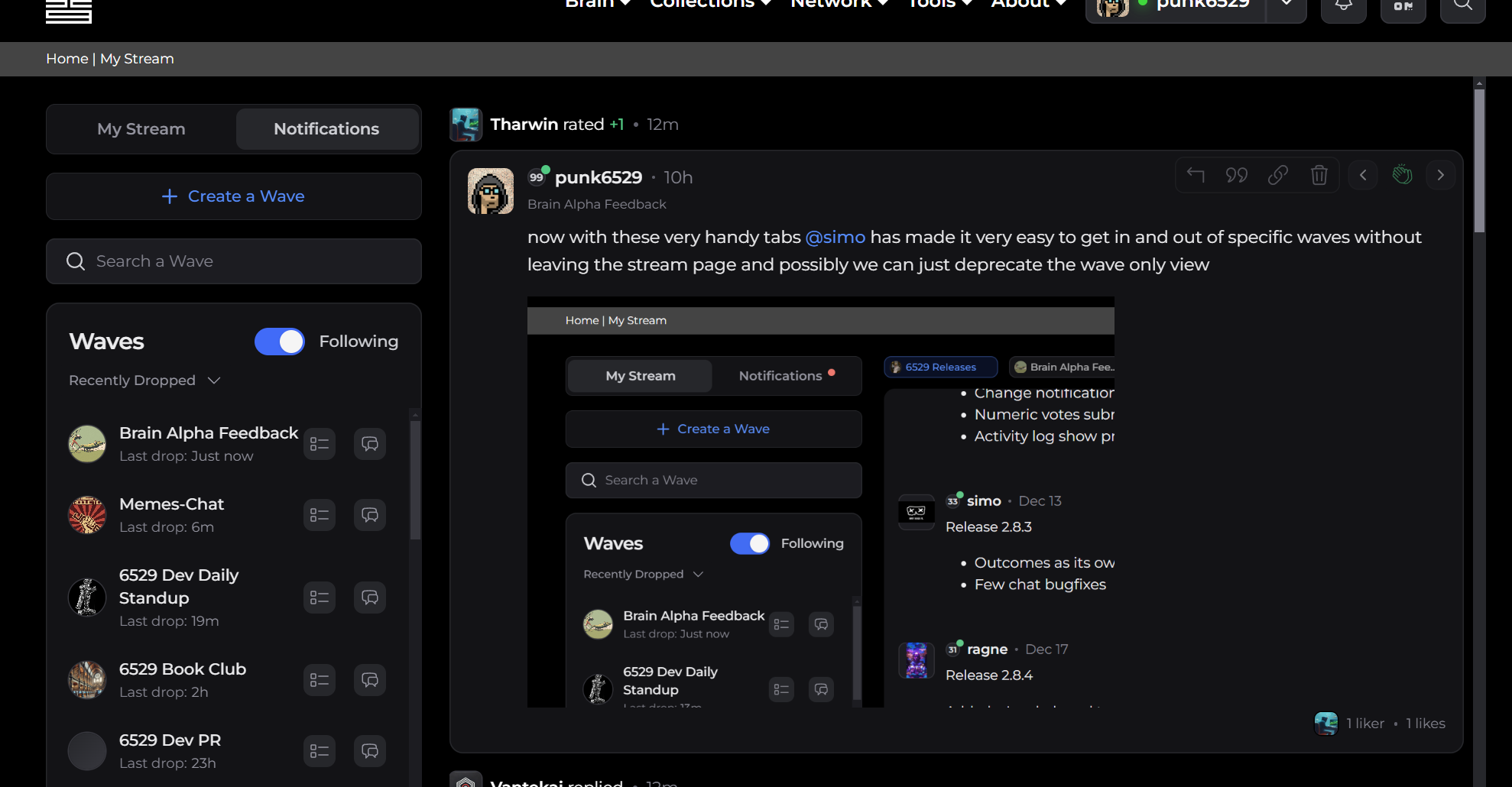
@[simo] @[ragne] this page should also have navigation at the top I think in some way
the good thing with 6529 is that:
a) it is one of the best known brands in the NFT space
b) we have no competing brands in the world like it and we have decent trademark protection
and if you prefer, i can leave ;)
I think some replies got eaten up by your new release
when I was replying
I replied to this message "For a group that is all in on a project about coordination, we are … not efficient at it"
The issue is that there are no goodies involved and then it vanished. happened to me last night too
hey @[simo] can you check please
right now it is chit chat
we are going to make history in 2025!
gmeme
sweet