accelerate!
Shit Punk Says
Oceans of Wisdom
19,158
matching drops
#1459158
2026-09-22 15:17
happy friday
@[simo] you have gotten more aggressive about putting the PFP back on the side. I think you can be a bit less aggressive
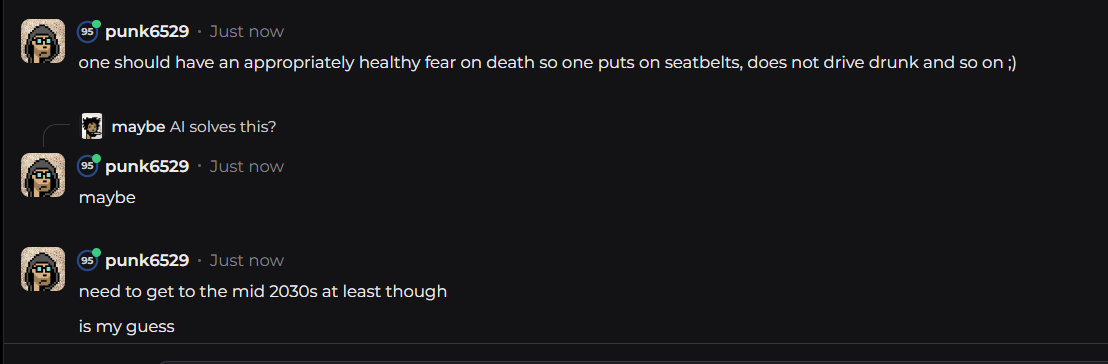
side note
is my guess
need to get to the mid 2030s at least though
yup, it is really fucked up
wait, this sounds really fucked up?
sadly, you (all/most) should assume you have higher cardiovascular, cancer and dementia risk, increasing the more times you get covid
unfortunately 6529 is going to be right on this one too
really causing trouble!!!
goddamn @[arsonic]
@[simo] when writing a longer drop you don't scroll down to keep the Drop button in sight
**Dev Priorities**
1. @[simo] is continuing his personal battle with the scrolling up scrolling and the many related topics. It has been harder than expected, he is nonetheless making progress, hopefully a couple of more rounds and it is smooth and performant
2. As #1 settles in, we need to go back to the make it work OK on the mobile apps. We know the UI is a bit of a mess right now (but ofc notifications are now working which is a good step forward)
3. After that, we will fix My Stream
4. Then take another go around at authentication across all platforms
5. I am cautiously optimistic that this week we can get to an acceptable chat experience across all platforms and can move on to voting
@[simo] if you are at the bottom of the screen typing a message and you add media it is off the screen and you do not know that you have added it. I think we should probably scroll a bit so you can see it?
@[ragne] I would take out the + sign from the storm icon as it overlaps and is confusing with the other plus sign. let's try leaving the plus sign as-is and leave just the storm icon for the storm. Also when you hit +, should be easier to get to upload media than add metadata as this is more common

@[simo] @[ragne] @[GelatoGenesis]
Situation:
1. I have posted in wave A
2. I am now in wave B
3. Wave A is correctly showing a recent drop (mine, which is correct)
4. But it is also showing me a pulsating notification of a drop (mine, which is not correct, I do not need pulsing notification that I just dropped into a wave; I already know that I did it)
@[simo] @[ragne] @[GelatoGenesis]
when you are in this situation clicking in the text box to lose the pop-up should work but it does not. you need to esc out. I think any action in the text box should work tbh and I think you are blocking the focus?

ok @[simo] is the group guru - he is on a later time zone these days and should be able to advise on the above
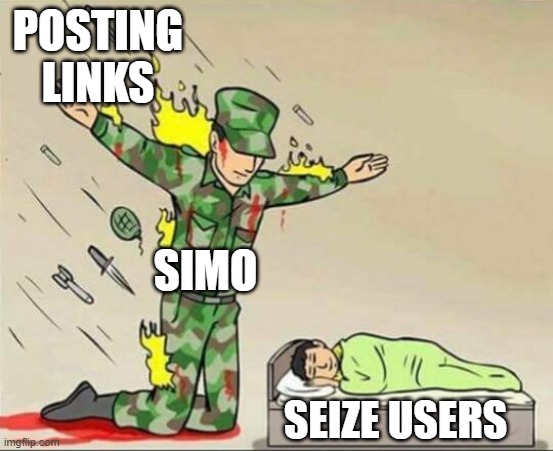
our current status
gmeme
@[simo] I think rating a post does not work as expected. if you rate click it quickly, the animation shows that multiple ratings are being added but the reality is that if you do not wait until the end of the animation to reclick only 1 rating is added
For the external audience, I would like to note that the oldest person on the dev team and the heaviest LLM user on the team is the same person and that person is me because I have apparently very strong anti-boomer brain module
even with unnumbered bullets, can you can you get more than 1?
- bullet
This is crazy
Yes, the passage you've shared accurately reflects key concepts from Tor Nørretranders' book *"The User Illusion: Cutting Consciousness Down to Size."* In this work, Nørretranders explores the relationship between consciousness, information processing, and the vast amount of sensory input our brains handle.
**Key Points from the Book:**
1. **Limited Conscious Processing:**
- **Sensory Input Volume:** Our senses receive an enormous amount of data—estimated at around 11 million bits of information per second.
- **Conscious Awareness Capacity:** Of this vast input, our conscious mind can process only a tiny fraction—approximately 16 to 40 bits per second.
- **Unconscious Processing:** The majority of sensory information is processed unconsciously. This unconscious processing is crucial for everyday activities that require expertise and automatic responses, such as speaking fluently or riding a bicycle.
2. **The User Illusion Concept:**
- **Simplified Reality:** Nørretranders uses the term "user illusion" to describe how our conscious mind provides a simplified version of reality, much like a computer's user interface hides complex processes behind simple visuals.
- **Discarding Information:** He argues that consciousness involves discarding vast amounts of information, focusing only on what's deemed essential for conscious thought and decision-making.
3. **Perception Delay:**
- **Half-Second Gap:** There's a measurable delay (about half a second) between when events occur and when we become consciously aware of them. This is due to the time it takes for sensory information to be processed and reach conscious awareness.
- **Implications for Action:** Skilled activities, such as hitting a baseball, rely on unconscious processing because the conscious mind is too slow to react in real time.
4. **Modern Society and Sensory Deprivation:**
- **Information Age Paradox:** Despite the abundance of information technology, Nørretranders suggests that modern life can lead to sensory deprivation by limiting the richness of direct, multisensory experiences.
- **Need for Holistic Engagement:** He advocates for engaging with the world through all our senses to fulfill our innate need for rich and varied sensory input.
**Conclusion:**
Your excerpt captures the essence of Nørretranders' arguments about the limitations of conscious thought, the significance of unconscious processing, and the importance of experiencing life beyond the confines of simplified, screen-based information. His work encourages readers to recognize the depth of unconscious cognition and to seek more immersive, sensory-rich experiences—like spending time outdoors in nature—to fully engage with the world.
Enjoy your time touching some grass (and forest)! Engaging with nature is a wonderful way to stimulate your senses and appreciate the complexities of perception that Nørretranders discusses.
Yes, many of the concepts presented in the passage from Tor Nørretranders' *"The User Illusion"* are consistent with modern scientific understanding, particularly within the fields of cognitive psychology and neuroscience. Let's examine these points in detail:
**1. **Limited Conscious Processing vs. Vast Sensory Input**
- **Scientific Understanding:**
- **Sensory Information Volume:** The human brain receives a vast amount of sensory data every second. Estimates suggest that our senses can gather millions of bits of information per second.
- **Conscious Processing Capacity:** Our conscious awareness can only handle a small fraction of this information. Cognitive psychologists like Donald Broadbent and later researchers have proposed that attention acts as a filter, allowing only certain information into conscious awareness.
- **Supporting Research:** Studies on attentional bottlenecks and selective attention (e.g., the "cocktail party effect") demonstrate that while the brain processes extensive sensory input, only a limited amount reaches conscious awareness.
- **Conclusion:** The claim that we consciously process only a tiny fraction of the sensory information our brains receive aligns with current scientific understanding.
**2. **Unconscious Processing and Expertise**
- **Scientific Understanding:**
- **Implicit vs. Explicit Memory:** Skills like fluent speech and riding a bicycle rely on implicit memory (procedural memory), which operates without conscious awareness.
- **Automaticity:** Through practice, complex tasks become automatic, allowing us to perform them efficiently without deliberate thought.
- **Neurological Basis:** The basal ganglia and cerebellum are involved in processing these automatic skills, functioning largely outside of conscious awareness.
- **Conclusion:** The idea that unconscious processes handle most of our skilled actions is consistent with neuroscience and psychology.
**3. **Information Discarding and Conscious Thought**
- **Scientific Understanding:**
- **Selective Attention:** The brain constantly filters and discards sensory information to prevent overload.
- **Perceptual Load Theory:** High perceptual load tasks consume more attentional resources, leaving less capacity for processing irrelevant stimuli.
- **Cognitive Economy:** Discarding unnecessary information is essential for efficient cognitive functioning.
- **Conclusion:** The notion that much of thought involves the unconscious discarding of information aligns with theories of attention and cognitive processing.
**4. **Perceptual Delay Between Reality and Conscious Awareness**
- **Scientific Understanding:**
- **Neural Processing Time:** There is a measurable delay between sensory input and conscious perception due to the time required for neural processing.
- **Estimated Delays:** Studies estimate this delay to be in the range of several hundred milliseconds (e.g., Libet's experiments suggested a delay of approximately 500 milliseconds).
- **Implications for Action:** For rapid responses, the brain relies on unconscious processing to act promptly.
- **Conclusion:** The claim of a perceptual delay is supported by neuroscience, though the exact duration may vary.
**5. **Unconscious Action in Skilled Activities**
- **Scientific Understanding:**
- **Motor Skills and Reaction Time:** Athletes often rely on muscle memory and unconscious reflexes to perform actions too quickly for conscious thought.
- **Flow State:** Psychological flow involves deep immersion where actions become automatic, and conscious interference can disrupt performance.
- **Research on Athletes:** Studies on expert performance indicate that overthinking can hinder skilled actions.
- **Conclusion:** The idea that conscious deliberation can impede rapid, skilled actions is consistent with findings in sports psychology and motor learning.
**6. **The "User Illusion" and Sensory Deprivation in Modern Life**
- **Scientific Understanding:**
- **User Interface Analogy:** The concept of consciousness as a simplified interface to complex unconscious processes is a perspective shared by some cognitive scientists and philosophers.
- **Sensory Engagement:** There's growing evidence that rich sensory experiences contribute to well-being and cognitive functioning.
- **Technology and Sensory Input:** Excessive screen time may limit multisensory engagement, potentially affecting cognitive and emotional health.
- **Conclusion:** While more philosophical, the notion that modern technology provides limited sensory input compared to real-world experiences is a topic of discussion in psychology and social sciences.
**7. **Modern Society and the Pursuit of Richer Experiences**
- **Scientific Understanding:**
- **Nature and Well-being:** Research shows that spending time in nature reduces stress and enhances mood and cognitive performance.
- **Sensory Stimulation:** Engaging multiple senses promotes neural connectivity and can enhance learning and memory.
- **Information Overload vs. Meaningful Engagement:** The Information Age provides vast data, but not all information is enriching or meaningful.
- **Conclusion:** Advocating for fuller sensory experiences to improve quality of life is supported by psychological research on well-being.
**Areas Where Views May Diverge or Are Under Debate:**
- **Exact Quantification of Information Processing:**
- **Measurement Challenges:** Precisely quantifying bits of information processed consciously and unconsciously is complex and may vary across studies.
- **Individual Differences:** Processing capacities can differ between individuals based on factors like attention, expertise, and neurological health.
- **Interpreting the "User Illusion":**
- **Philosophical Perspectives:** Not all scientists agree on viewing consciousness purely as an illusion or simplified interface.
- **Alternate Theories:** Other models emphasize the integrative and emergent properties of consciousness.
- **Impact of Technology on Sensory Experience:**
- **Diverse Effects:** While technology can limit physical sensory input, it can also provide novel experiences and enhance connectivity in other ways.
- **Balance is Key:** The consensus suggests moderation and balance between virtual and real-world experiences.
**Summary:**
Overall, the passage captures concepts that are generally consistent with modern scientific understanding:
- **Unconscious vs. Conscious Processing:** The brain processes vast amounts of information unconsciously, with consciousness handling a limited subset.
- **Role of Unconscious in Skilled Actions:** Expertise often relies on unconscious processes for efficiency and rapid response.
- **Perceptual Delays:** There is a recognized delay between sensory input and conscious awareness, influencing how we perceive and react to the world.
- **Importance of Rich Sensory Experiences:** Engaging fully with our environment through all senses contributes to well-being and cognitive health.
**Note:** While the core ideas align with scientific findings, some interpretations are philosophical or metaphorical and may not represent a universal consensus. Ongoing research continues to explore these complex aspects of human cognition and consciousness.
**References for Further Reading:**
1. **Baars, B. J. (1997).** *In the Theater of Consciousness: The Workspace of the Mind.* Oxford University Press.
2. **Kahneman, D. (2011).** *Thinking, Fast and Slow.* Farrar, Straus and Giroux.
3. **Dehaene, S. (2014).** *Consciousness and the Brain: Deciphering How the Brain Codes Our Thoughts.* Penguin Books.
4. **Libet, B. (2004).** *Mind Time: The Temporal Factor in Consciousness.* Harvard University Press.
5. **Csikszentmihalyi, M. (1990).** *Flow: The Psychology of Optimal Experience.* Harper & Row.
6. **Posner, M. I., & Rothbart, M. K. (2007).** *Attention, Self-Regulation and Consciousness.* Philosophical Transactions of the Royal Society B: Biological Sciences, 362(1481), 759–770.
7. **Kaplan, S. (1995).** *The Restorative Benefits of Nature: Toward an Integrative Framework.* Journal of Environmental Psychology, 15(3), 169–182.
**Final Thought:**
Engaging with the world through all our senses and being present in our experiences can enhance our understanding of ourselves and our environment. As you venture outdoors to "touch some grass (and forest)," you're tapping into the rich sensory input that contributes to a fuller, more nuanced experience of life—a concept both ancient and reaffirmed by modern science.
@[simo] we have lost bullet points in the latest build?
Recently Dropped
Recently Dropped By You
Most Dropped
Most Dropped By You
Most Subscribed
High Level Author
Author You Have Repped
Recently Created
I think this below that I am about to paste is closer to the right order - switch to this pls for now?
more generally the order of the menu is kindof not in order of logical priority
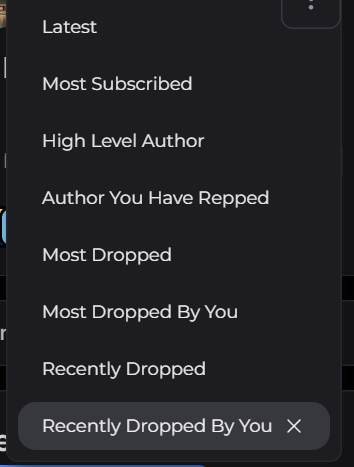
@[simo] I really love the "recently dropped" sorting on waves. makes the widget 100x more useful. I am not sure I understand Latest and how that is different from Recently Dropped. Is it "the latest creation date of a wave"
Also don't understand High Level Author (what is the level? are they sorted by level? does it exclude oneself, etc)
minor thing for @[simo] or @[ragne], need alignment with "Just now" - should be right aligned
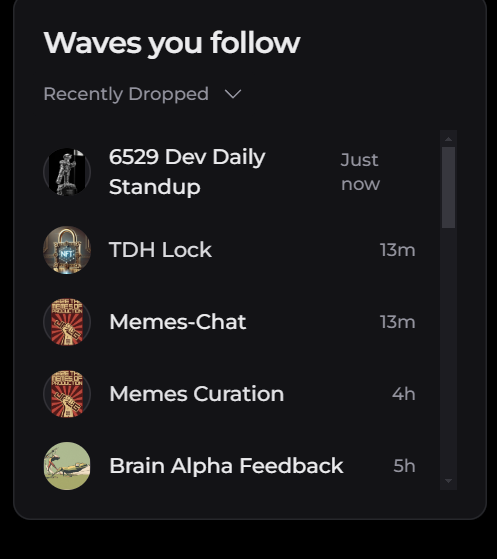
yup yup links are broken
@[6529er] is undefeatable
:)
@[arsonic] - ish type resolutions
it is going to be ridiculous
blown up full size
look at the size of that brain
https://x.com/punk6529/status/1841153072027836752
Siddhartha is very elegant, very austere.
Zorba is also incredible and makes more sense if you have read Siddhartha first
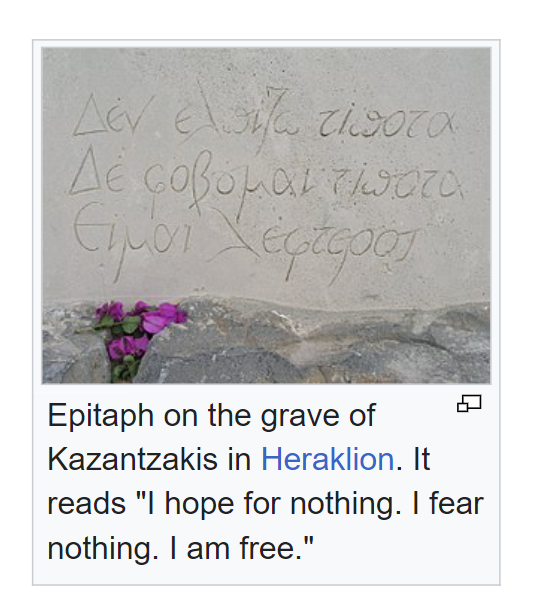
Generally Kazantzakis was a chad - wrote last temptation of christ, got ex-communicated, etc
" In 1957, he lost the Nobel Prize to Albert Camus by a single vote. Camus later said that Kazantzakis deserved the honour "a hundred times more" than himself. In total Kazantzakis was nominated in nine different years."
has the world's best gravestone too.
Siddharta for me is far above the rest though.. Haven't read Zorba but if you put it in that company Ima start it ASAP..
a lot of things are about to (hopefully) happen in Q4 this year
almost Q4
LFG
absolutely killer book, one of my favorite books of young adulthood, up there with Siddhartha and Zorba the Greek
Just started reading Zen and the art of Motorcycle maintanence..
if only there was a solution for this....
https://x.com/levelsio/status/1840012820890747339
but we are on the right track
gmeme