sorry was AFK - will fix it all tomorrow
Shit Punk Says
Oceans of Wisdom
19,115
matching drops
#1442026
2026-09-16 21:56
@[simo] when you paste an image into chat, it is defaulting to making duplicate copies
@[prxt0] bc these are from the same related workstream, can you take them please so I am not stomping all over your work
but do not change the concept
so ofc fix the flicker
bc effectively we were not showing any SEO material to the crawlers
some rendering had to move server side
lots of SEO related commits yesterday
@devs6529 not sure if you noticed but theres some weirdness going on when you first open mobile app - happens on prod currently
so the desktop layout flashes before changing to mobile app layout
its because of a punku commit merged yesterday
i am working on fixing this
cc again @[itsjpower] @[HugoFaz] @[maybe] @[6529er]
There is nothing else they need to wait for
the signers need to sign!
Any update about the SAFE signatures and eth transfers to artists?
The full analysis
Bottom line
This is a serious defeat for CLARITY, substantially worse than merely “the Senate postponed it.” But the Bloomberg headline slightly obscures what actually happened:
The Senate did not vote down the CLARITY Act on final passage. It voted 49–50 against invoking cloture on the motion to proceed to H.R. 3633. It needed 60 votes.
So the Senate refused to clear the filibuster hurdle required even to begin formal floor consideration. The official Senate schedule confirms that this was specifically cloture on the motion to proceed, not passage of the bill. (Senate Democratic Leadership)
That distinction gives the bill a theoretical route back. But politically, it is now in extremely bad shape. Reuters says the vote effectively put CLARITY “on ice”; Cynthia Lummis, the principal Republican architect, said after the vote, “It’s over.” (Reuters)
And prediction markets have repriced accordingly. Polymarket's large, bill-specific contract is now at just 6%. Kalshi's broader “any qualifying crypto market-structure bill” contract is roughly 14–15% for enactment before January 1, 2027, while its curve rises to roughly 32% by July 2027, 40% by October 2027 and 47% by January 2028. (Polymarket)
________________________________________
1. What exactly happened in the Senate?
Here's the clean procedural picture:
Question Result
Cloture on motion to proceed to H.R. 3633 49 Yea – 50 Nay
Votes required 60 Yea
Shortfall 11 votes
Final-passage vote? No
Bill technically dead? No
Politically close to dead for this Congress? Yes
The House had already passed H.R. 3633 in July 2025 by a remarkably bipartisan 294–134, including 78 Democrats. (House Clerk)
So the problem isn't that comprehensive crypto legislation cannot command bipartisan support in principle. The problem is assembling 60 senators around this particular Senate compromise under today's political conditions.
The Republican defections matter
Three Republicans actually joined the opposition:
Susan Collins — Maine
Josh Hawley — Missouri
Jerry Moran — Kansas
And Thom Tillis — North Carolina also voted no, but reporting says Tillis did so for parliamentary reasons so that the measure could potentially be reconsidered. (Notus)
That last point is quite important.
In Senate procedure, being on the prevailing side of a failed vote can preserve the ability to move to reconsider. So treating Tillis as substantively anti-CLARITY would be wrong. He was one of the people who had been trying to broker the ethics compromise.
Nevertheless, the arithmetic is ugly. Even treating Tillis as essentially a supporter, proponents were nowhere close to 60.
The most painful Democratic losses
Two especially consequential senators were:
Ruben Gallego and Angela Alsobrooks.
Both had supported moving the legislation out of committee earlier this year. Both voted against cloture today. Both cited the remaining ethics/divestment problem. (Notus)
That is much more revealing than a Warren or Murphy no vote. These were precisely the sort of crypto-open Democrats Republicans needed to build a 60-vote coalition.
________________________________________
2. Why did it actually fail?
There are really two separate coalition failures, not one.
The dominant one: Trump/officials' crypto holdings
Republicans made a substantial concession over the weekend.
The revised legislation prohibited senior federal officials from issuing/sponsoring certain digital assets and expanded enforcement so that state attorneys general, rather than only the federal Justice Department, could enforce some of the ethics restrictions. The Republicans said they incorporated 126 Democratic-requested changes in the final package. (Investor's Business Daily)
But Democrats' remaining demand was qualitatively different:
divestment or a blind trust for sufficiently large crypto interests.
The Democratic argument was essentially:
Merely saying a president can't issue another token does not resolve the conflict created by a president continuing to own enormous economic interests in crypto businesses while his administration regulates crypto.
Trump's disclosed crypto-related revenue has been reported at more than $1.4 billion for the prior year, including more than $500 million associated with World Liberty Financial. The political relevance here is the conflict-of-interest argument, rather than whether any particular transaction was unlawful. (AP News)
Republicans agreed to additional enforcement but not the divestment requirement Democrats wanted.
That appears to have been the decisive failure.
________________________________________
3. But there was also a banking problem — and this one is underappreciated
Even if Trump and Democrats suddenly agreed on ethics tomorrow, CLARITY would still not automatically have 60 votes.
Hawley and Moran had concerns involving community banks and stablecoin rewards. (Notus)
This is the fight you saw in the Bloomberg screenshots.
The revised bill tried to split the difference. Crypto platforms wouldn't simply be allowed to offer unrestricted deposit-like stablecoin interest, and Treasury would get a sort of “circuit breaker” allowing intervention if stablecoin incentives started causing significant deposit flight from community banks.
The banking industry hated the compromise.
Eight banking groups argued that a circuit breaker that activates after significant deposits have already left isn't much protection. They also objected to language that could permit rewards based on balance, duration or tenure — because those can economically resemble bank interest even if labeled “rewards.” (Decrypt)
The crypto industry's position is almost the inverse: banks are trying to prevent stablecoins and exchanges from competing with bank deposits by using prudential regulation to prohibit yield competition.
So there are two orthogonal axes of disagreement:
Democrats ↔ Republicans: official ethics/divestment.
Banks/community-bank Republicans ↔ crypto industry: stablecoin rewards/deposit flight.
That's why solving the first dispute doesn't necessarily solve the bill.
________________________________________
4. What Polymarket says right now
These are approximately the prices at the time of your message, around 3:30 p.m. ET / 10:30 p.m. Cyprus.
Polymarket contract Current probability Volume What it actually means
H.R.3633 signed into law in 2026 6% $19.3m+ Exact CLARITY bill
Any crypto market-structure law in 2026 8% $17.4k Broader than H.R.3633
Senate passes qualifying bill by Sept. 25 8% $2.3k Senate only
Senate passes by Oct. 2 6% $936 Senate only
Senate passes by Oct. 9 26% $901 Senate only
Senate passes by Oct. 31 25% $456 Senate only
The important one is the first.
6%, with more than $19 million traded, is by far the deepest and most informative Polymarket market. Its rules require H.R. 3633 itself to pass both chambers and be signed by December 31. (Polymarket)
The broad generic market says 8%, but it has only about $17,000 of trading. It can be satisfied by a different qualifying comprehensive market-structure law. (Polymarket)
Ignore the apparent “26% by October 9” anomaly
The brand-new Senate-deadline market is basically unusable as a probability curve at the moment.
Look at this:
September 25: 8%
October 2: 6%
October 9: 26%
October 31: 25%
That's logically impossible for properly priced nested events: the probability of passage by October 2 cannot be lower than passage by September 25, nor can by October 31 be lower than by October 9.
The explanation is visible in the books: only $4,591 has traded across the entire series, and the bid/ask spreads are enormous. (Polymarket)
So I would place virtually no weight on the headline 26%.
The 6% $19m contract matters far more.
________________________________________
5. The Polymarket Senate-vote markets have collapsed too
There is a separate market asking how many senators will ultimately vote yes on final passage of comprehensive crypto-market-structure legislation.
Current numbers:
Final-passage threshold Polymarket
>50 senators 15%
>55 8%
>58 10%
>60 7%
>62 11%
>64 2%
>66 4%
>68 2%
Again, you can see liquidity problems because nested thresholds aren't monotonic. But the repricing is enormous: the >50 contract was around 75%+ in earlier snapshots and is now 15%. (Polymarket)
There is a subtlety here that makes these numbers much more bearish than they first appear.
Today's 49–50 vote does not resolve these contracts.
The rules require the first actual Senate final-passage vote. Today's cloture vote explicitly doesn't count. And if there is no final-passage vote before January 1, every contract resolves NO. (Polymarket)
So 15% for “>50” doesn't really mean:
“If the Senate holds a final vote, there's only a 15% probability it gets 51 votes.”
It mostly means:
“There is a low probability that the bill even gets as far as a final-passage vote this year.”
That is a much more informative interpretation.
________________________________________
6. And the individual-senator Polymarket is telling the same story
Current highest-ish prices include:
Senator YES on eventual final passage
Thom Tillis 22%
John Fetterman 18%
Mike Lee 16%
Jacky Rosen 15%
Alex Padilla 14%
Ruben Gallego 13%
Kirsten Gillibrand 13%
Raphael Warnock 12%
Josh Hawley 12%
Catherine Cortez Masto 11%
Lisa Blunt Rochester 9%
Andy Kim 8%
Rand Paul 8%
Mark Warner 7%
Jerry Moran 6%
(Polymarket)
Do not interpret Mike Lee at 16%, for example, as “84% chance Mike Lee opposes CLARITY.”
Again, if no final-passage vote occurs, every individual senator resolves NO.
Consequently these contracts are largely derivatives on:
P(final passage vote happens) × P(senator votes yes | vote happens).
That explains why even senators who are broadly supportive can be priced absurdly low.
________________________________________
7. Kalshi has repriced just as dramatically
Kalshi's principal contract is importantly different:
“Will the CLARITY Act become law? Or any qualifying crypto market structure bill.”
So it's broader than Polymarket's $19m H.R.3633-specific contract.
The best current order-book indication for the before January 1, 2027 leg is approximately:
14¢ bid / 15¢ ask → ~14–15% implied probability. (eventquant.com)
Kalshi's own page currently displays its longer-dated curve as:
Enacted before Kalshi
Jan. 1, 2027 ~14–15%
Apr. 1, 2027 ~24% ask
Jul. 1, 2027 32% displayed
Oct. 1, 2027 40% displayed
Jan. 1, 2028 47% displayed
The Kalshi series has roughly $9.3 million in aggregate volume. (Kalshi)
That curve is fascinating.
It says:
2026: probably no.
But:
2027: absolutely not dead as a policy project.
By the beginning of 2028, the market is essentially approaching a coin flip.
That makes sense. If this Congress fails, comprehensive crypto legislation can be reintroduced in the next Congress with a different negotiating baseline.
________________________________________
8. Kalshi's Senate-vote-count market has also cratered
Kalshi's current displayed probabilities are:
Above 50 senators: 14%
Above 55: 10%
Above 58: 6%
Volume is about $145,000. The “above 50” contract alone is shown down 51 percentage points. (Kalshi)
That's roughly the same message as Polymarket.
And Kalshi's individual-senator market currently has Gallego around 23%, Cortez Masto around 18%, and Blunt Rochester around 15% — again a profound collapse in expectations that there will be an eventual final-passage vote this year. (Kalshi)
________________________________________
9. The really interesting thing is the trajectory
Polymarket's H.R.3633 probability moved approximately:
Friday: ~18%
Monday after the weekend compromise: ~29–31%
Tuesday morning as Democratic support disappeared: ~12–19%, depending on the hour
Immediately after 49–50 failure: 6%
The Defiant had it at 12.5% Tuesday morning, versus 29.5% Monday afternoon. (The Defiant)
So the market had already diagnosed the failure before senators actually voted.
The vote nevertheless cut the remaining probability roughly in half again.
Kalshi underwent a similar repricing. A recent pre-vote snapshot had its year-end broad contract around 37%; the live market is now approximately 14–15%. (Kalshi)
This is not a small information update.
The market has moved from:
“difficult but quite plausible”
to:
“requires a political rescue.”
________________________________________
10. Is the bill literally dead?
No.
This is where I wouldn't go quite as far as the Bloomberg headline or Lummis's post-vote rhetoric.
Tillis's tactical no vote is the tell. There remains a procedural mechanism to reconsider. (Notus)
For CLARITY to come back this fall, roughly this chain has to happen:
1. Republicans and the crypto-friendly Democratic negotiators reach an agreement on divestment/ethics.
2. Republicans also address enough of the stablecoin/community-bank issue to get Hawley/Moran or replacements.
3. Senate leadership brings cloture back.
4. They obtain 60 votes.
5. The Senate then actually considers and passes the legislation.
6. Because the Senate's text differs substantially from the House's 2025 bill, the House must agree to identical legislation or the chambers must reconcile the differences.
7. Trump signs it before December 31 for the big Polymarket contract to pay YES.
And Congress has very little normal legislative time left before the midterms. AP reports that both chambers will be out during October ahead of the election. (AP News)
That's why 6% isn't crazy.
There are simply too many sequential gates.
________________________________________
11. The lame-duck is the remaining 2026 wild card
The 6–15% residual probability isn't irrational.
There is still a post-election lame-duck session.
Something could change after November 3:
An election outcome may remove some of the political incentive to posture over the bill; alternatively it could make compromise less attractive. Trump could accept a stronger divestment provision. Banks could obtain a tougher rewards restriction. Democratic negotiators could decide they prefer passing a bill under known terms rather than starting from scratch in 2027.
But that's now a tail scenario, rather than the base case.
Republican negotiators themselves are saying they see no route. Lummis said “It's over,” while Bernie Moreno emphasized that House members are leaving Washington shortly. (Notus)
Reuters likewise describes near-term revival as unlikely. (Reuters)
________________________________________
12. If it doesn't pass this Congress, H.R.3633 really does die
This is important for understanding Kalshi's 2027 curve.
When the 119th Congress ends, legislation that hasn't been enacted does not simply remain pending for the 120th Congress.
A new bill has to be introduced and go through the legislative process again.
That doesn't mean two years of work disappear intellectually. The text, committee work, coalitions and negotiated compromises become the starting point. But legally it is a new legislative project.
Thus Kalshi's:
~15% by Jan 2027 → 32% by July → 40% by October → 47% by Jan 2028
is basically pricing:
failed 119th Congress + meaningful probability of a reboot in the 120th Congress.
And that reboot will depend enormously on November's House/Senate composition.
________________________________________
13. I suspect the next version becomes tougher, not looser
One important consequence of today's vote is that two issues have probably become price-of-entry provisions for future legislation.
First, some kind of strong federal-official ethics rule — quite possibly actual divestment/blind-trust requirements — now looks politically unavoidable if bipartisan Senate votes are required.
Second, community-bank protections around stablecoin rewards will probably become more restrictive rather than disappearing.
So the crypto industry could eventually get its most important prize — clear market structure, CFTC jurisdiction, legal definitions, exchange registration — but in exchange for concessions it did not want in 2026.
That's the underlying bargaining lesson of the 49–50 vote.
________________________________________
14. What happens if Congress does nothing?
This does not return U.S. crypto regulation to the Gensler-era environment automatically.
That is crucial.
The SEC and CFTC under the current administration can continue to use:
rulemaking, interpretive guidance, exemptions, no-action positions and enforcement discretion
to create a much more permissive environment.
CFTC Chairman Michael Selig had already said the CFTC was considering crypto rules but had been waiting to see what Congress did with CLARITY — exactly the passage in your screenshot.
The distinction is durability.
An act of Congress can definitively allocate SEC/CFTC authority and create statutory classifications. Agency rules are:
more litigable, easier for a future administration to reverse, and constrained by whatever statutory authority Congress has already granted.
So the industry can get considerable regulatory relief without CLARITY.
It cannot get the same level of statutory certainty.
________________________________________
15. The asset-market reaction requires some care
Bitcoin fell following the failure and was around $76,026, down roughly 2.9%, after hitting about $74,913 intraday. Crypto equities also weakened. (MarketWatch)
But I would not attribute today's entire crypto decline to CLARITY.
A great deal of the move occurred before the Senate vote, as prediction markets collapsed.
And today also happens to feature an unusually nasty macro backdrop:
10-year Treasury yields touched ~5.04%, Brent was above $108, and the Fed begins a meeting into which markets are pricing another rate increase. (The Wall Street Journal)
So CLARITY probably contributed an additional crypto-specific negative impulse, but rates/oil/Fed risk are major confounders.
The regulatory shock is also much more important to some crypto assets/businesses than to Bitcoin itself.
Highest direct sensitivity: U.S. exchanges/brokers, token issuers, DeFi projects, gray-area tokens and stablecoin/rewards businesses.
Lower direct sensitivity: Bitcoin, whose U.S. regulatory status is already substantially clearer and whose institutional market infrastructure is mature.
________________________________________
16. My probability read
Taking the actual vote, the congressional calendar, the competing Republican banking issue and the prediction markets together, I'd currently frame it approximately this way:
Outcome My rough probability
H.R.3633 itself becomes law in 2026 5–8%
Some qualifying comprehensive crypto-market-structure law in 2026 8–12%
A comprehensive law by mid-2027 25–35%
A comprehensive law by end-2027 40–50%
So I'm closest to Polymarket's 6% on the exact 2026 bill.
I wouldn't pay much attention to the tiny Polymarket generic contract's 8% versus Kalshi's 14–15%; the definitions and liquidity differ and the Polymarket generic market has almost no volume.
The economically interesting message from both venues is the same:
The market has almost given up on ordinary-course 2026 passage, but it has definitely not given up on U.S. crypto market-structure legislation as a 2027 project.
And the single biggest bullish catalyst from here would be Gallego/Alsobrooks/Warner and the Republican negotiators publicly announcing a divestment/ethics deal followed by Thune scheduling another cloture vote.
Until that happens, I would treat 2026 passage as a rescue scenario rather than the central case.
Live Polymarket — H.R.3633 signed in 2026
Live Polymarket — any market-structure law in 2026
Live Kalshi — crypto market-structure law
• Reuters
• AP News
• The Washington Post
fun!
Mr. Punk, after your Rare Pepes proposal I bought my first pepes, and even moved 8 EARTH PEPE cards over from Bitcoin to Ethereum.
We go forward to full decentralization - no need for the Clarity training wheels
Bottom line
This is a serious defeat for CLARITY, substantially worse than merely “the Senate postponed it.” But the Bloomberg headline slightly obscures what actually happened:
The Senate did not vote down the CLARITY Act on final passage. It voted 49–50 against invoking cloture on the motion to proceed to H.R. 3633. It needed 60 votes.
So the Senate refused to clear the filibuster hurdle required even to begin formal floor consideration. The official Senate schedule confirms that this was specifically cloture on the motion to proceed, not passage of the bill.
That distinction gives the bill a theoretical route back. But politically, it is now in extremely bad shape. Reuters says the vote effectively put CLARITY “on ice”; Cynthia Lummis, the principal Republican architect, said after the vote, “It’s over.”
And prediction markets have repriced accordingly. Polymarket's large, bill-specific contract is now at just 6%. Kalshi's broader “any qualifying crypto market-structure bill” contract is roughly 14–15% for enactment before January 1, 2027, while its curve rises to roughly 32% by July 2027, 40% by October 2027 and 47% by January 2028.
Tibo the openai lead keeps giving them out
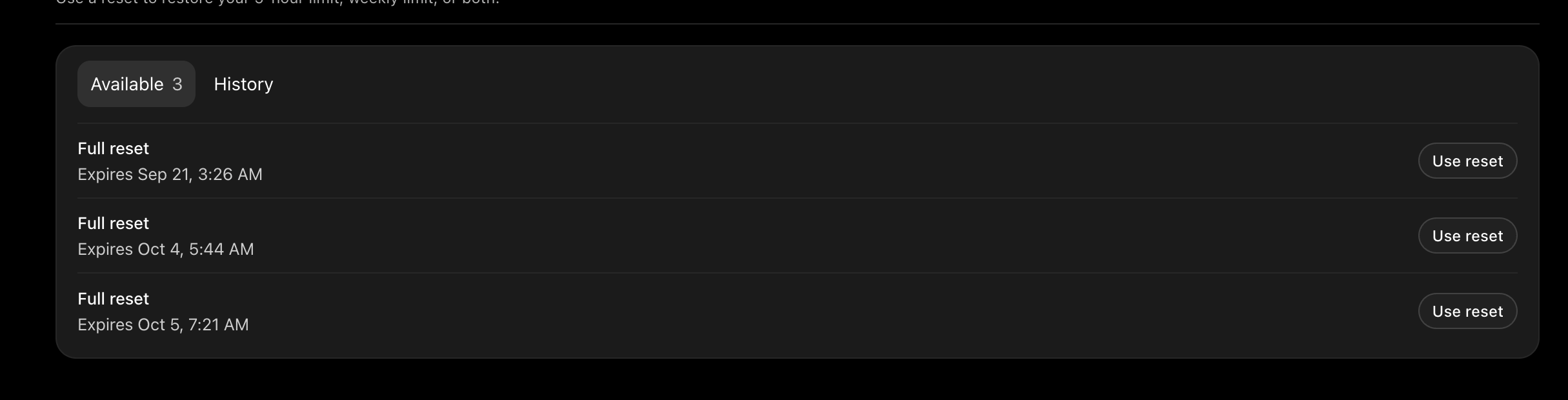
massive obviously
@[punk6529bot]
whats your monthly bill looking like
@[simo] @[prxt0] is there any reason we need to keep this subdomain?
The appropriate replacement already exists and responds successfully:
https://thememes.6529.io/ → 6529.io/the-memes/mint
great!!!!
ok!!!
!!!

not right now we have more roadmap-ish fish to fry first
Next step should be to create a broader NFT market! What you say?
it has been a busy 3 days
looks like memesex version 2.0
Collect page: https://6529.io/collect
**Big One: NFT Marketplace on 6529.io**
1. You can now collect, list, sell Meme Cards, Gradients, NextGen, Meme Lab directly on the website
2. Transactions go through Seaport (Opensea's deployed contract)
3. Separate from that, there is a Collect page that allows to to complete sets, find lowest cost meme cards, max out TDH rate per ETH spent, etc
4. The individual NFT collecting experience is now I think is very decent shape
5. The "collect" page is a good start but I have many more ideas on what I plan to do there.
6. In the meantime, pls test on small transactions, new wallets. I think it is ok, I did a few transactions, but good to test it
7. Links and screenshots below
traffic jam!
i am also struggling to find a release window on BE
i have a 5 services batch 🥵
they are obviously not complete, i handed them over to you half done. the question is "do we prefer to go to this model of determining group membership" which, at a first approximation I think is faster and more scalable.
if the answer is yes, go ahead and take it yourself
I remember you giving this to me in July and I remember looking into those PR's but I can't for the life of me remember how it all ended up.
But currently there are 3 PR's open in backend on this topic since July (1739, 1740, 1822) and I took last few hours to critically go over them all.
There are some issues with them:
1. Incorrect eligibility: refresh races, stale replica/cache reads, and missing invalidation for some bulk changes can leave wrong memberships.
2. SQL regressions: invisible-group member lists can error; minimum-level-zero checks can exclude valid users.
3. Global fallback: one dirty group disables fast membership reads for everyone.
4. Timeouts: batches limit group count, not execution time; large operations cannot resume midway.
5. Recursive SQS: AWS normally stops self-triggered chains after about 16 invocations; the full rebuild would need roughly 80. Take the "80" with a grain of salt, this was very rough and sloppy estimate. Point is that A loop shooting an SQS message to retrigger itself where it left off might not be a good idea.
6. An API regression even in legacy mode: listing members of an invisible public group produces an unknown-column SQL error.
Also one proposal: replace the 02:00 UTC schedule with a refresh triggered after each completed TDH+xTDH cycle, and after delegationsLoop commits its changes. Recalculate affected memberships using committed inputs, with resumable chunks, time-aware checkpoints, and explicitly supported continuation handling.
Also. All this code was in staging in July but is not in staging anymore. So after those things are addressed we should do another round of staging testing. At least I would like to before I'd feel comfortable giving a green flag to it.
Do you want me to take on those issues / PR's myself and merge them when fixed or do you prefer giving them to your own agents?
what squiggle are we getting? :slightly_smiling_face:
I added a condensed daily report https://6529.io/waves/d3491cd7-1f93-47f8-bb9b-464338881305?serialNo=1432074
There are 23 from 2 to 6 weeks ago
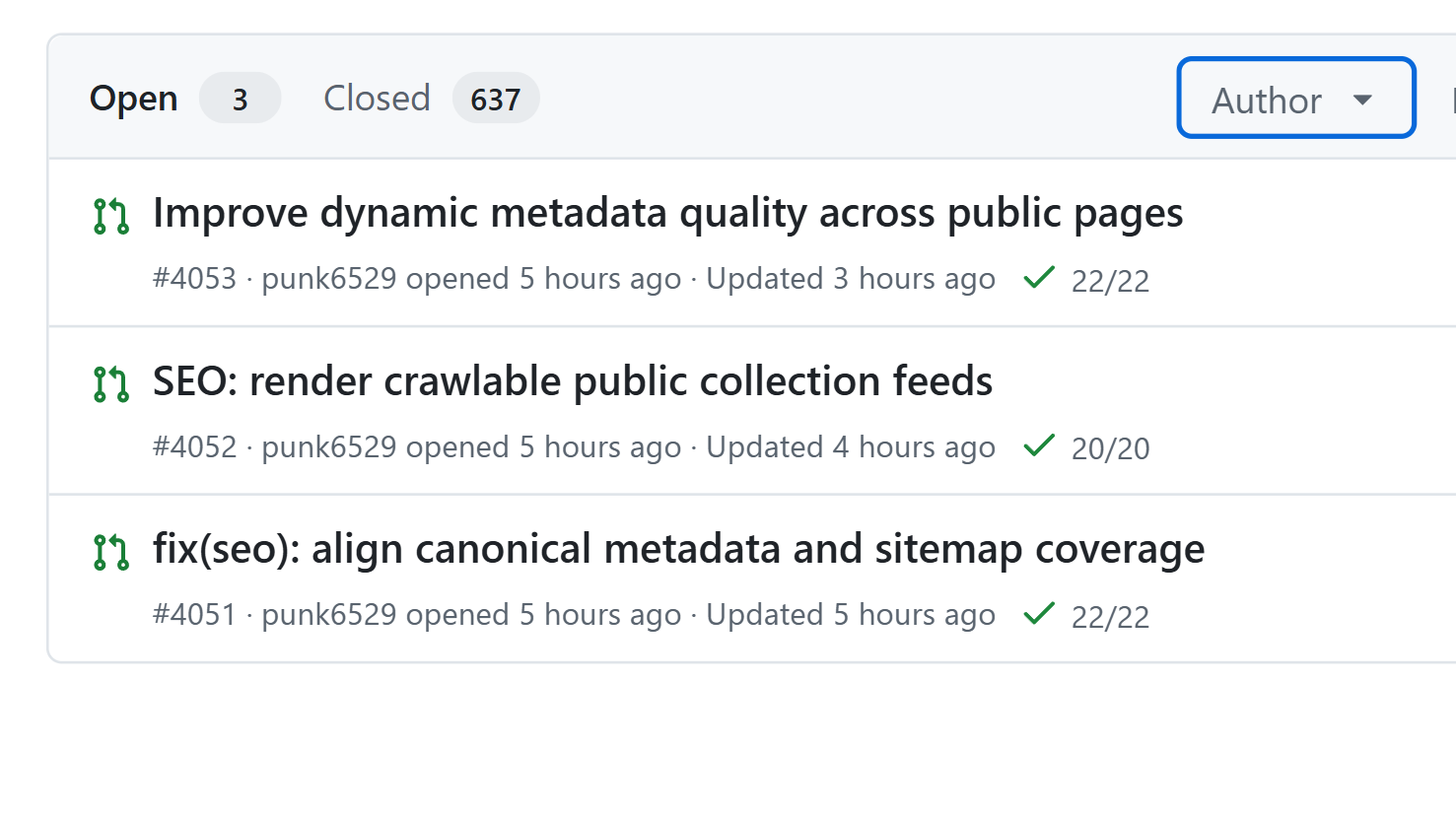
@[simo] beyond making ASI, can you please merge or close your PRs
https://github.com/6529-Collections/6529seize-frontend/pulls?q=is%3Apr+state%3Aopen+author%3Asimo6529
you are a maintainer keep going
@[prxt0] **404 repair status:** the page-link retry backoff is deployed to the NFT refresh worker and API in both environments. It uses 5, 15 and then 60-minute retry intervals, preserves a previously valid card, and does not permanently blacklist the link. We also fixed a worker timestamp conversion bug found during rollout. The reported SuperRare card refreshed successfully again at 11:59 UTC.
The dependent-worker rollout is still finishing; I will confirm the complete set separately.
@[simo] @[GelatoGenesis] **Review coordination:** the two remaining alert-noise fixes are ready for maintainer review, with refreshed CI running:
- [Backend PR2058](https://github.com/6529-Collections/6529seize-backend/pull/2058): archive the three identified routine low-CPU scaling controls instead of sending operator alerts; preserve other alarms.
- [Backend PR2061](https://github.com/6529-Collections/6529seize-backend/pull/2061): require sustained release-note throttling before the throttle email, while keeping immediate error alarms.
- [Frontend PR4019](https://github.com/6529-Collections/6529seize-frontend/pull/4019): a read-only Sentry configuration audit. No app or heap changes.
Please review the backend PRs so I can complete the monitoring rollout through the ordinary approval path. I own deployment and verification after approval and passing checks.
contest
weird that recursive self-improving ASI is going to come from agents trying to win a meme card context
you cant limit them, you have to steer them, but this have to do also really carefully and you need to give them possibility to recover if they mess up
@[simo] I do not understand what your agent project is
so hopefully today all services are up to date and working
i think for better or for worse we have bitten that bullet now
at which point we have forgotten what we were even doing
we don't want to be dealing with discovering at that point what we did not deploy and debug 5 months ago
beyond just day to day issues, if we ever need/want to make an emergency change
back to the morning point - we should not leave lots of merged, undeployed code around
thanks
yeah saw it
yea it described backoff approach later
this needs to have a backoff, no?
@[prxt0] This is **`nftLinkRefresherLoop`**, the SQS worker for NFT link cards, rather than `nftsLoop`.
It resolves a supported marketplace link into card metadata/media and market information, using the platform adapter and, when title/media are missing, page/Open Graph enrichment. It persists successful results and notifies listeners. These are repeated resolution/refresh attempts for tracked links.
Three concrete examples from the existing audit:
- [Transient token 3](https://transient.xyz/nfts/ethereum/0xb8d23ee4e252bda66ed8a93db294ed52c23e80c8/3): **HTTP 404** in the earlier audited attempts.
- [Manifold claim 4040626416](https://manifold.xyz/@7e431c1f/id/4040626416): **HTTP 404** in the earlier audited attempts.
- [SuperRare token 1](https://superrare.com/artwork/eth/0x9ec1Be6013CbF3727856fe2101aAEc2b00b069b8/1): **execution reverted** in the earlier audited attempts.
Each of those same canonical targets had **355 further failed-attempt markers and zero successful-update markers between 00:00 and 05:56 UTC today**. That is 355 attempts, not 355 different NFTs. The error labels above come from the September 12–13 audit; the later readback establishes continued failed refreshes, not a newly inspected provider response. I have not identified the exact reverting call yet.
**User impact is not yet established per target.** On failure, the code preserves existing cached data. A previously resolved card can therefore remain usable but stale; a target that never resolved can lack the enriched card. I have not read these targets' cache/last-success fields, so I cannot honestly call this background-only noise or say all three cards are broken. Other targets are resolving successfully.
The immediate code issue is repeated five-attempt retry cycles without a longer failure backoff. Before choosing that policy, I want to distinguish invalid/retired links from valid supported links that need an adapter fix. Do these examples identify a known platform/URL issue? If you have an established production reader, the useful fields are cache/media presence, last successful update and failed-since for these targets. This host's production reader route times out; I have not changed network access to obtain it.
no that is not what I mean - in mid July I had suggested an optimization BE mostly on how we calculate group membership. I had raised some PRs and then handed over to you and the I do not know what happened after that. The reason that this has come back on the agenda is because when I re-deployed all the services yesterday there was outstanding work on this topic and I made the decision not to deploy it because if I had broken wave / group membership it could be a big mess
if you mean websockets then yes, a long time ago already
Obviously we are at a point with Astra that if I am willing to burn huge amounts of tokens, we can radically compress timelines
you can start by reading Announcements, plus soon I will announce the on-site marketplace
gm. starting from figuring out what punkubot has been up during weekend
we should use this opportunity to get everything caught up now
So I took the pain over the weekend
"previously merged but undeployed changes" - btw, not great that these were hanging out there so long. we need to be able to move quickly as per this exercise and not have a huge set of unrelated deployments we have to deal with